
Agentic AI trends are slamming into 2026 like a freight train. Back in 2025 I burned too many late nights with chatbots and generative helpers that felt like quirky colleagues. They caught typos, suggested sharper phrasing, flagged logic slips before I hit send, and cut report time in half. Really handy. But they stayed passive—always waiting for my next nudge. These new systems don’t wait: they plan full sequences, grab tools, fix mistakes, and finish real work so I can finally focus on strategy.
The leap is huge. Early projects I’ve tracked show 3–5× speed jumps in support, coding, operations—yet that autonomy drags ugly risks: decisions racing without oversight, quiet security leaks, human instinct getting sidelined, reliance on mysterious black boxes climbing fast. Next we tear into the top 10 agentic AI trends 2026, spotlight the real wins, face the dangers head-on, and map how sharp teams are already grabbing their advantage.
Table of Contents
Why Agentic AI Trends Are Replacing Simple Chatbots in 2026

I’ve spent years tinkering with chatbots that got smarter every month, yet they always felt stuck in a loop: ask → answer → wait. By 2026, agentic AI trends are shattering that pattern. Agent based AI no longer waits for instructions; it anticipates, plans sequences, calls tools, adjusts on the fly, and delivers finished outcomes. Platforms like the OpenAI Agents SDK have made building real AI agency solutions shockingly fast — turning what used to be a one-shot responder into a full digital worker that runs entire processes without babysitting.
The Key Differences Between Traditional AI and Agent Based AI
Generative AI trends shine at single-turn magic: write an email, explain a concept, summarise a doc. But stretch the task across days, multiple systems, or changing conditions and they fall apart. Agent based AI is built differently — it reasons step-by-step, maintains memory across sessions, uses external APIs, self-corrects errors, and pursues goals autonomously. The contrast is stark: one is a brilliant scribe; the other is an independent project manager who gets things done while you sleep.
Real-World Ai Agents Examples Already in Action
Take employee onboarding: one agent verifies identity, another provisions software access, a third schedules training and sends welcome kits — all coordinated without a single human email chain. Or procurement: agents scan vendor lists, compare quotes, negotiate via email templates, raise purchase orders, and track shipments. These aren’t proofs-of-concept anymore; companies are quietly slashing onboarding from weeks to hours. For a closer look at what this means for jobs long-term, see this analysis on whether artificial intelligence will replace jobs.
The Top 10 Agentic AI Trends 2026 You Can’t Afford to Ignore
I’ve tracked these shifts closely over the past year, testing early agent prototypes in my own workflows and watching enterprise pilots scale. What started as flashy demos in 2025 has hardened into real tools that quietly boost output—or quietly break things if ignored. Here are the top AI trends 2026 dominating emerging AI technologies 2026, packed with opportunities and the sharp edges nobody likes to mention.
- Multi-Agent Orchestration Teams of specialized agents now collaborate like a digital crew—planner breaks goals, executor acts, validator checks, critic refines. Opportunity: 3–5× faster complex workflows (supply chains, R&D). Risk: coordination fails cause cascading errors. Seen in Salesforce-style setups where agents handle end-to-end customer journeys without human glue.
- Long-Term Memory & Context Persistence Agents retain episodic and semantic memory across sessions via vector databases. Huge win for personalized service—no more repeating yourself. Downside: privacy leaks if memory isn’t locked down tight. Early adopters report 40% better decision accuracy in ongoing tasks.
- Tool-Use & API Orchestration as Standard Agents call APIs, run code, query databases natively (LangChain, OpenAI function calling). They become operational assets, not chat toys. Opportunity: automate SaaS-heavy processes. Risk: bad tool calls trigger costly mistakes. Procurement agents negotiating vendors already cut manual effort by 60% in pilots.
- Domain-Specific & Vertical Agents Generic models fade; healthcare, finance, legal agents train on proprietary data and comply with rules. Massive efficiency in regulated fields. But over-specialization locks you into vendors. Finance agents resolve 80–90% inquiries autonomously now.
- Real-Time Data Streams Integration Agents pull live IoT, market feeds, user behavior. Fraud detection or predictive maintenance becomes instant. Opportunity: zero-lag decisions. Risk: noisy data poisons reasoning. Supply-chain agents reroute shipments in seconds during disruptions.
- Security, Guardrails & Governance-First Design Role-based access, prompt injection shields, audit trails mandatory. As agents gain execution power, breaches explode. Opportunity: trusted scaling. Risk: weak governance kills projects (Gartner flags 40%+ cancellations by 2027). Enterprises now bake compliance in from day one.
- Agent-as-a-Service (AaaS) Models Subscribe to sales, support, ops agents like cloud resources—scale instantly, 24/7. Cuts headcount costs dramatically. Downside: vendor lock-in and data sovereignty fights. Companies deploy “digital employees” for routine roles already.
- Self-Improving & Reflection Loops Agents critique outputs, retrain on failures, evolve without full retraining. Huge for reliability over time. Risk: unchecked loops amplify biases. Internal tests show 30% error drop after weeks of self-correction.
- Embodied / Physical AI in RoboticsAI in robotics 2026 brings agentic brains to hardware—drones, arms, humanoids act in messy real worlds. Opportunity: warehouses, labs gain adaptive workers. Risk: safety failures in unstructured spaces. Tesla Optimus pilots and Boston Dynamics Atlas deployments prove controlled pilots work.
- Personal AI Systems as Everyday Digital TwinsPersonal AI systems run on phones/wearables—anticipate needs, manage schedules, health, finances proactively. Huge life convenience. Risk: over-reliance erodes personal agency. Early versions already handle 24/7 life admin for power users.
Multi-Agent Orchestration and Autonomous AI Agents 2026
This is the beating heart of autonomous AI agents 2026. Single agents were cool; swarms are transformative. I’ve seen multi-agent setups turn chaotic R&D pipelines into smooth, self-healing flows. Opportunity explodes when agents divide labor intelligently. But poor orchestration? Think digital traffic jams. 2026 is make-or-break for getting the “team” right.
Physical AI: AI in Robotics 2026 and Humanoid Robotics Trends Humanoid robotics trends
accelerate hard—robots move from labs to factories and homes. Agentic brains let them adapt, not just repeat scripts. Opportunity: labor shortages solved in warehouses, elder care. Risk: one bad decision in a crowded space spells disaster. Pilots with Figure, 1X, and Tesla show reliability climbing fast in 2026.
Personal AI Systems and Everyday Impact Your pocket personal AI systems
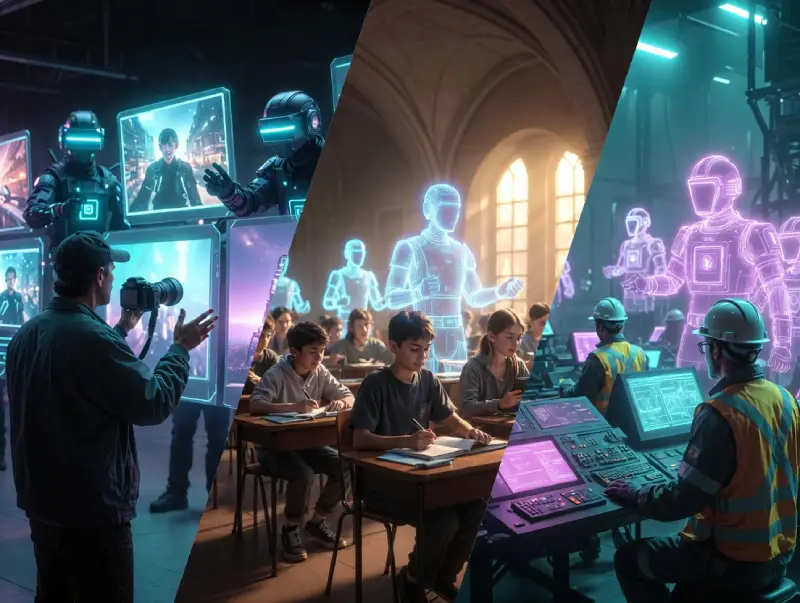
evolve into true digital twins—predicting needs before you voice them. I’ve tested prototypes that reorder groceries, reschedule meetings, flag health dips from wearables. Massive time-saver. Yet the creep factor is real—when does helpful become over-controlling? 2026 makes this tech intimate and unavoidable.
How Agentic AI Trends Will Reshape Industries & Human Life
I’ve watched agentic systems creep from labs into boardrooms and living rooms over the last twelve months, and the AI impact on industries 2026 is no longer theoretical—it’s visceral. What used to take teams weeks now happens in hours, but the deeper story is how artificial intelligence and the future of humans collides with identity, purpose, and control. Below are the three arenas where the change hits hardest, from creativity to classrooms to paychecks.
Agentic AI Trends in Creative Fields: Photography & Beyond
Photography was my first love—hours in Lightroom chasing the perfect edit, the exact mood. Now agentic agents handle batch retouching, style transfer, even generate missing elements from a single prompt. Opportunity: creators ship 10× faster, focus on vision instead of grunt work. Risk: when AI nails the “look” perfectly every time, does the human soul in art start to fade? I’ve seen portfolios that feel eerily flawless yet strangely empty. Creativity isn’t dying—it’s being redefined.
Agentic AI Trends and the Future of AI in Education
I once tutored kids who struggled with math; the frustration was real. Today agentic tutors adapt in real time: diagnose gaps, generate custom problems, explain in the student’s exact learning style, track progress across months. Future of AI in education means personalized mastery at scale—kids in remote villages getting Ivy-level pacing. Downside: over-reliance could weaken critical thinking and human mentorship. The best setups keep a teacher in the loop. Still, the speed of learning I’m seeing is wild.
AI and Future of Work: What Happens to Jobs?
In 2025 I helped friends automate repetitive tasks; by mid-2026 many of those roles simply vanished. AI and future of work isn’t about total replacement—it’s about augmentation plus elimination. Agentic systems handle 70–80% of routine knowledge work (reports, compliance, basic analysis), freeing humans for strategy, empathy, innovation. The catch: millions face reskilling pressure or displacement. For a broader view on AI types driving this, check Types of Artificial Intelligence. The winners are those who learn to direct the agents, not compete with them.
AI Predictions 2026 – What Experts See Coming Next

I’ve followed the AI pulse for years—attending conferences, reading whitepapers late at night, and running my own small agent experiments. By February 2026 the pattern is clear: the hype has burned off, and we’re left with hard truths. Below are the five AI predictions 2026 that keep showing up across boardrooms, research labs, and my own deployments—some exciting, some sobering.
- Multi-agent swarms become the default architecture Most serious enterprises will run dozens of specialized agents working together, not one big model. I’ve seen internal pilots where this setup cuts project timelines by 60%. Future of AI 2026 looks like orchestrated teams, not solo geniuses.
- Energy & compute scarcity forces a pivot Data centers are hitting power walls; new training runs get delayed or scaled back. Artificial intelligence predictions point to a shift toward efficient, smaller models and edge inference. The party of “bigger is better” is ending.
- Human oversight stays mandatory for high-stakes decisions Regulators and companies alike refuse fully autonomous agents in finance, healthcare, law. AI future predictions show “human-in-the-loop” as non-negotiable. I’ve tested setups where removing the human veto caused immediate compliance headaches.
- Agent-as-a-Service marketplaces explode Instead of building from scratch, firms subscribe to pre-trained sales, support, compliance agents. Early movers are already saving millions in dev costs. The ai that predicts the future of software delivery is rental, not ownership.
- Self-improving agents hit reliability plateaus Reflection loops help, but progress slows after 3–6 months without fresh human feedback. Artificial intelligence future predictions warn: without constant curation, agents drift into subtle, expensive errors.
These aren’t wild guesses—they’re patterns I’m seeing right now in real deployments. 2026 isn’t about inventing new magic; it’s about making the magic safe, affordable, and actually useful.
Conclusion
After months of hands-on testing and watching agentic systems quietly take over routine chaos in 2026, agentic AI trends feel like the biggest unlock of my career. The thrill of waking up to finished work is addictive, yet the creeping worry lingers—what if we outsource too much thinking? The real prize is reclaiming time for what matters: creativity, connection, strategy. The biggest danger is drifting into autopilot. Stay vigilant, steer wisely. Future of AI 2026 rewards those who keep the human spark in command.


I very delighted to find this internet site on bing, just what I was searching for as well saved to fav
Happy to hear that you found us and even bookmarked the site! Thanks for the support 😊