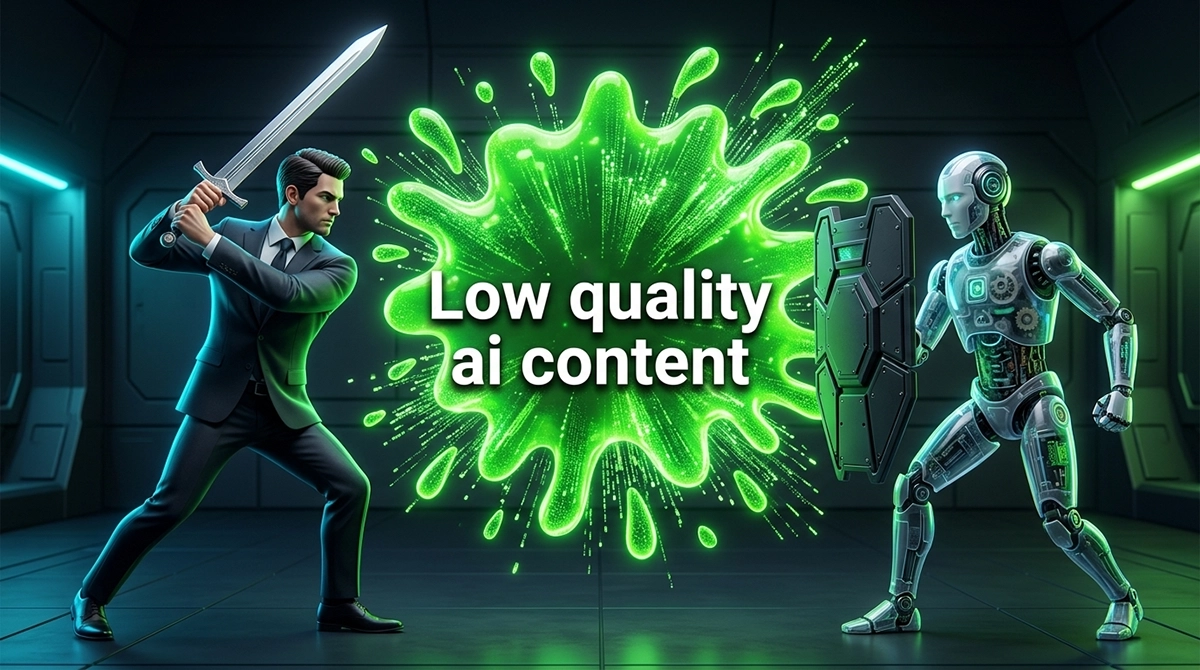
I have often explored the evolving relationship between creators and machines here, notably in my piece, “Can AI Replace Writers?” However, a recent article claiming that someone is “secretly writing with AI” sparked a serious debate in my mind. Is using an ai content tool actually a crime? Critics often attack highly structured pieces, but I argue that low quality ai content isn’t caused by the tool itself. The issue lies in how people perceive organized, efficient, and high-level digital assistance.
The real question isn’t whether the text is structured, but whether it lacks soul or substance. When a writer uses an ai content generator to build a robust framework, they aren’t cheating; they are optimizing. We must stop blaming the technology for the rise of ai slop. Instead of fearing automation, we need to distinguish between a professional using an ai article writer as a sophisticated assistant and someone lazily publishing unedited, robotic junk that provides zero value to the reader.
Table of Contents
The Anatomy of “Low Quality AI Content”
Many writers today have significantly increased their publishing speed, but in my experience, higher speed doesn’t always mean lower quality. While low-quality content is often a byproduct of rushing, a well-structured article can actually improve through smart assistance. The real danger arises when people use a single, simple prompt without any research or personal input. This lazy approach is exactly what leads to the production of low quality ai content, turning what should be a tool for growth into a liability for your brand.
Why Publishing Speed Is Killing Quality
If you move forward with analysis and use AI as a partner, your output won’t just be massive; it will be meaningful. Many believe that faster publishing leads to better business, but if you prioritize speed over depth, you lose user trust. Using an AI Writing Assistant to help with research and structuring can actually enhance your quality rather than just increasing volume. However, publishing superficial information without any critical thinking only makes your content look like every other repetitive website.
The Myth of “AI-Only” Content
When we write, we must find the right topic, analyze every angle, and integrate keywords effectively. Personally, I always handle keyword research first because it informs the article’s angle. Then, I use AI to help me build a powerful, logical structure. For me, AI acts solely as a sophisticated assistant, not an employee that handles the final output. The defensive attitude some people have toward using ai content is simply a mistake. If you use the tool correctly to create a strong, structured piece, you aren’t replacing your brain; you are empowering it.
How “Generic Writing” Devalues Your Authority
A major sign of low quality ai content is the reliance on generic, predictable, and robotic text. The more superficial your workflow, the more obvious this becomes to readers. When articles are merely rewritten versions of existing internet noise, users feel they are reading a cheap copy. This happens even without AI, but you can easily avoid it by combining your own unique experience with AI-driven structures. If you consistently add deep research and valid data to your ai content, you provide a unique value that builds lasting authority and reader trust.
What Is “AI Slop” and Why Does It Matter?

The term “AI Slop” has quickly become a hot topic in the digital community, which is exactly why I wanted to address this. It refers to content produced in massive, unthinking quantities without any real editing, research, or clear purpose. Content creators often publish this noise blindly, hoping for a quick spike in traffic. However, we must understand that the real problem isn’t the technology itself, but the complete lack of human direction. This negligence is what turns automated text into meaningless digital waste that clutters the search results.
Distinguishing Between Structural AI Writing and “Slop”
AI can be an incredibly powerful tool for content creation if used professionally. I always emphasize that even in my previous articles, the goal is to create something structured and strong, not to generate ai slop. I have seen writers use AI for brainstorming, drafting, and organizing ideas, but then they add their own research and personal experience. This process transforms a simple draft into valuable content, ensuring the final result is a high-quality piece rather than a repetitive mess.
Why Readers Reject Forgettable, Repetitive Content
Users decide within seconds whether to stay on a page or leave. If your content consists only of clichés, repetitive information, and explanations they have heard a thousand times before, they will leave. I experience this myself; when I visit websites that provide no new insight, I leave immediately. To prevent your content from becoming low quality ai content, you must move beyond generic patterns and provide the unique, human-centric depth that machines cannot replicate without your guidance.
My Workflow: Using AI as an Assistant, Not a Replacement

My development workflow has evolved, but it never relies on automation to do the thinking for me. Whether I am architecting a new feature or documenting API endpoints, I view these tools as a junior team member that requires strict supervision. The mistake most people make is expecting the output to be “production-ready” immediately. I treat every draft as a base layer that must be heavily refactored, just like I would with untested legacy code. Efficiency comes from the human-in-the-loop, not from blindly trusting an AI Content Generator to handle complex tasks without oversight.
Why You Need Human Judgment in Every Draft
Writing, much like coding, is an iterative process of refinement. When I use an AI Content Writer, I am merely sketching out the skeleton of my argument. The muscle, the nerves, and the actual brainpower—the nuance of why a specific Laravel package fails under load, or why a specific architecture pattern is better for scalability—must come from my own hands. If you are not injecting your own experiences, your draft is just noise. You need human judgment to ensure the logic flows, the technical accuracy holds up, and the solution actually solves the problem at hand.
Pressure-Testing AI Output with Real-World Experience
I often subject my drafts to “pressure tests” similar to how I stress-test a server. Does this advice hold up in a high-traffic environment? To bridge the gap between automation and expertise, it helps to look at how a skilled AI Software Developer approaches complex systems. You must verify every claim with your own scars. If I cannot back up a paragraph with a specific situation from my career, I delete it. Avoiding low quality ai content starts with rejecting generic text; using AI tools to replace your unique perspective is a path to failure.
The Search Standard: Quality Control Over Automation

Google’s ranking algorithms have shifted their focus toward “Helpfulness” and user-centric intent. This means the debate regarding the origin of content is becoming irrelevant. As a lead dev, I care about the deployment result, not the IDE used to write the code. If your content provides genuine answers that help a user navigate technical hurdles, you will rank. The obsession with whether an article is machine-written is a distraction; the real enemy is low quality ai content. What matters is simple: does this provide legitimate, actionable information to the reader?
Does Google Actually Punish AI?
The fear of being penalized is largely based on myths about E-E-A-T guidelines. Google does not have an automatic “kill switch” for AI Content Detection. If you provide a deep, technical dive into a problem that only someone with years of experience could write, the algorithm sees that value. I have seen many articles written by machines that survive perfectly fine because they were heavily edited by an expert. It is not about the technology; it is about who holds the final authority over the facts, the technical nuances, and the actual utility provided.
Why “People-First” Content Wins Over AI Detection
Ranking in today’s search environment requires an authentic “People-First” approach. As an AI Blog Writer, my objective is to solve a specific pain point for the developer reading my site. I don’t use automation to fluff the word count; I use it to structure complex technical ideas. When I add specific code snippets or explain why a certain database query caused a deadlock in production, I am providing “Information Gain.” This is how you combat low quality ai content. You cannot automate the genuine, lived experience of a real developer solving real, complex software problems.
The Difference Between Automation and Authentic Expertise
The difference between low-quality noise and a high-ranking article is simply the presence of an AI Article Writer who knows when to stop automating. I know exactly when to cut the AI generated text and take over with my own keyboard to explain the “why” and “how.” Automation is a great tool for speed, but authenticity is what builds authority. When you combine your professional expertise with streamlined digital assistance, you create a resource that stands out. That is how you win in a search landscape saturated with generic, unedited, and hollow machine-generated text.
Conclusion
The debate over AI in content creation is largely a distraction. If there were a fundamental problem with machine-generated text, Google would not integrate Gemini directly into search results. The issue is not the technology; it is the blind reliance on unverified drafts. My workflow proves that AI serves as a powerful assistant, not a replacement. Using it is acceptable only when it actively elevates the quality of your output. Publishing raw, unedited text is what leads to low quality ai content. Be the editor, add your technical expertise, and ensure every article provides genuine value.