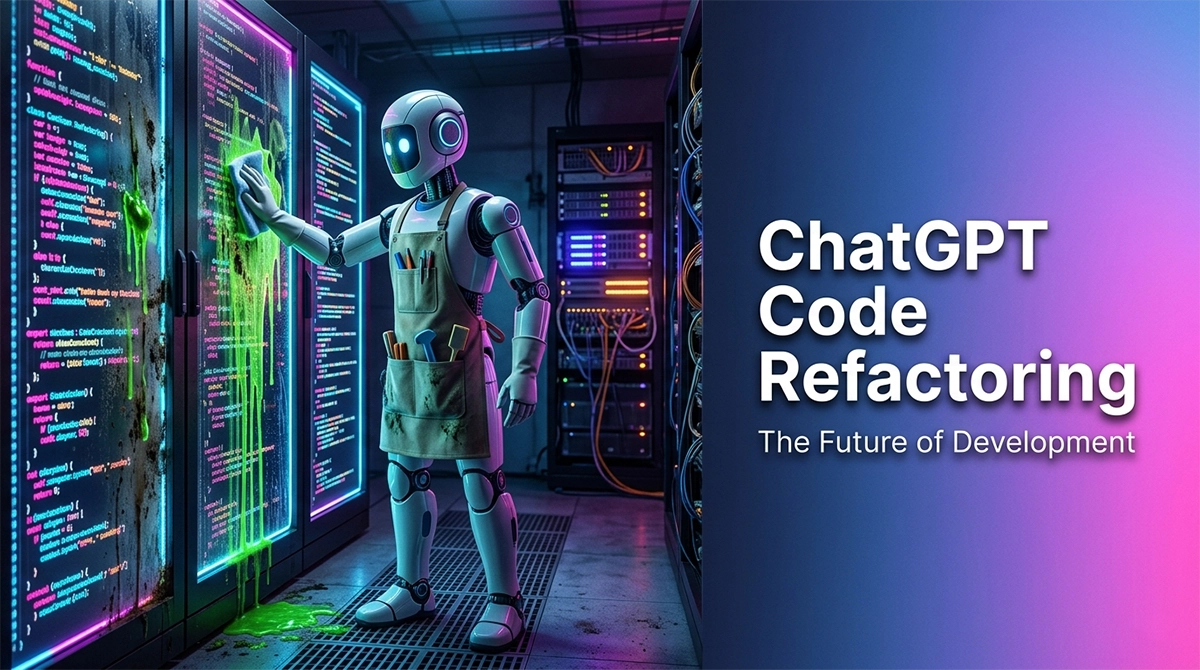
Deploying chatgpt code refactoring into my backend architecture completely transformed how I deal with messy, inherited applications. For years, I have focused on writing clean, principled code from day one, but we often inherit chaotic systems where previous engineers did not care about readability. Manually fixing this unreadable spaghetti code used to be a painful, time-consuming nightmare. Integrating this AI-driven approach allowed me to instantly optimize messy logic, add accurate documentation, and eliminate technical debt efficiently.
Despite these advanced tools, many developers still copy-paste generic AI code without enforcing strict architectural standards. If you do not guide the AI on how you want your code written, it defaults to average, messy structures. My multi-week experiment proved that you can successfully use AI prompts for coding to clean up deep legacy systems. This guide shares my personal, real-world framework for using ChatGPT as a high-level refactoring assistant to safely migrate messy applications into structured architectures.
Table of Contents
Is ChatGPT Good at Refactoring Code?

When testing automated tools on complex, enterprise-level structures, developers naturally ask: Is ChatGPT good at refactoring code? Based on my extensive software development engineering, the answer is a definitive yes, but it requires highly strategic management. I regularly use LLMs to analyze messy logic, generate documentation, and suggest structural improvements. However, treats these tools as highly competent development assistants rather than independent, autonomous software architects who understand production environments.
To get the most value out of your workflow, documenting your process and learning from a real-world ChatGPT Experience allows you to build a safe, contextual bridge before linking systems together. During my architectural migrations, I realized that the model respects programming principles perfectly if you actively prompt it to do so. It can easily implement design patterns, map dependencies, and suggest clean architectural boundaries if you force it to reason through the code step-by-step.
Can ChatGPT Modify Code Safely?
When analyzing if can ChatGPT modify code safely without breaking production, my personal experiments taught me to monitor the outputs closely. I once fed a chaotic, one-thousand-line search query file into the model and ordered it to apply the Specification Pattern. The AI successfully generated the isolated file structures, but it completely forgot to include several existing filtering methods inside the final class.
This taught me that while the model handles complex structural refactoring beautifully, it frequently suffers from context window memory drops. I had to manually review the code and re-add the missing filters using my own design principles to make it function correctly. The tool can modify syntax rapidly, but human validation remains entirely mandatory to prevent silent system failures in live runtime environments.
What Is the Best AI to Refactor Code for Backend Architecture?

Engineers frequently debate what is the best AI to refactor code when dealing with decoupled backend systems. While GitHub Copilot is excellent for real-time inline suggestions and Claude excels at digesting massive text files, ChatGPT remains my preferred choice for high-level architectural brainstorming. Its dedicated coding models understand structural constraints deeply, allowing you to ask specific questions about software design patterns before running modifications.
The Strategy: How to Prepare Your Code for AI
Successfully executing chatgpt code refactoring depends entirely on how you organize your codebase before pasting it into the prompt interface. You cannot simply dump a giant, unorganized file and expect a clean, production-ready system architecture. You must first break down the logic manually, define clear folder structures, and establish clear architectural rules that the AI must follow throughout the translation.
Breaking Spaghetti Code Into Clean Domains
To answer can ChatGPT improve my code, you must first isolate your messy monolithic functions into standalone, clean domains. As an AI Software Developer, I’ve found that AI delivers far better results when the project already follows a clear architecture. Before I ask the model to rewrite any logic, I use specific directives to map out the folder hierarchy and class boundaries. This preparation prevents the AI from mixing independent business logic layers, ensuring the refactored classes remain modular, isolated, and much easier to maintain over time.
Why Generic AI Prompts Fail in Web Development
Using generic chatgpt prompts for web development like “clean this code” will always cause database crashes and broken application builds. Generic prompts force the network to guess your business goals, resulting in missing logic and imaginary variable assignments. Instead, you must explicitly declare your design patterns, enforce strict SOLID rules, and tell the model how to structure the folders before it generates any code.
The Prompts Masterclass: Practical Examples for Developers
Mastering chatgpt code refactoring requires moving past basic instructions and using strict structural boundaries. In my development environment, I treat the LLM like an advanced engine that needs clear constraints to prevent bugs. To share my personal journey, I built five explicit templates that transformed my messy backend legacy methods into clean systems. These blueprints will act as your dedicated refactoring assistant skill, helping you shape clean code rules safely.
Core Chatgpt Code Refactoring Prompt for SOLID Design
Before optimizing your architecture, you need a solid foundational instruction layout. I spent weeks refining this specific chatgpt code refactoring prompt to ensure the model stops inventing fake classes. By forcing a Chain-of-Thought step first, the neural network maps out the logic before rewriting the actual clean syntax. For more advanced workflows, agent mode in ChatGPT can help developers handle complex coding tasks by analyzing project structures, suggesting improvements, and assisting with multi-step refactoring processes.
Prompt: Act as a Senior Backend Architect specializing in clean code and Laravel. Your task is to analyze the provided PHP controller method for code smells, high cyclomatic complexity, and SOLID violations.
Before writing any refactored code, provide a brief bulleted list explaining:
- Which core SOLID principles are currently being broken.
- A step-by-step strategy to fix them.
Constraints:
- Do not alter existing database column names, third-party API keys, or input/output payload structures.
- Use strict typing and descriptive variable names.
- Do not introduce new external dependencies.
Here is the code to analyze: [Insert Code]
Specialized AI Prompts for Coding Domain Isolation
When building a Modular Monolith, extracting independent domains into dedicated service directories is crucial. I use these specialized coding prompts for ChatGPT to separate mixed logic like billing data and notification files. This targeted strategy ensures that individual modules communicate cleanly without creating hard dependencies.
Prompt: I am moving my application to a Modular Monolith architecture. The code below contains mixed domain logic (Billing and Notifications).
Review this script and extract the notification logic into a separate, isolated Service class. Use dependency injection to call this new service from the original class. Ensure that the two domains only communicate via clean interfaces, keeping the core database transactions safe.
Here is the code: [Insert Code]
Advanced Prompt to Code Guard Clauses
Deep nesting makes files unreadable. I designed this specific prompt to code layout to flatten deep conditional blocks using early return patterns. It allows me to rapidly clean up old scripts while ensuring the error boundary states remain perfectly intact.
Prompt: Review this legacy function strictly for readability and logical flow. Refactor the syntax using early return patterns and guard clauses to eliminate deep nesting.
Make sure all error handling boundaries and specific HTTP status codes are perfectly preserved. Do not optimize database calls yet; focus entirely on flattening the logical structure.
Legacy code: [Insert Code]
Database Refactoring Prompt for Safe Eloquent Transactions
Handling heavy database queries is where simple automation fails completely. I use this advanced prompt for refactoring code to ensure that complex insert and update executions are wrapped in safe database transactions. This approach prevents data corruption when modifying deep legacy code.
Prompt: Act as a Database Expert. Look at this legacy backend method that runs multiple insert and update queries.
Refactor this code to use explicit database transactions (
DB::transactionorDB::beginTransaction). Ensure that if any step fails, the entire operations rolls back safely. Preserve all existing error log commands within the catch block exactly as they are written.Here is the code: [Insert Code]
Automated Regression Test Generation Prompt
You should never rewrite code without creating a proper safety net. I rely on customized AI prompts for coding to automatically build robust integration tests before running any architectural migration. This step ensures that the refactored output matches the original business execution logic perfectly.
Prompt: Write a comprehensive Pest or PHPUnit integration test for the legacy function provided below.
The test must cover:
- The happy path (successful execution with standard data).
- Edge cases (empty inputs, invalid user status).
- Error states (failed database connection).
Provide mock setups for any external API requests included in the code.
Here is the function: [Insert Code]
The Limits: Where AI Refactoring Breaks Down

While exploring automated engineering solutions, understanding system boundaries is just as critical as writing efficient configurations. Relying on continuous chatgpt code refactoring workflows can save hundreds of hours of manual rewriting, but the system is not entirely foolproof. During my multi-week architecture experiment, I discovered that language models often lack true contextual awareness of complex, interconnected enterprise frameworks. When you ask yourself, can AI refactor code flawlessly, the answer is always tied to human supervision; if you give the engine full autonomy without setting strict operational boundaries, it will confidently generate elegant syntax that completely misinterprets your runtime requirements and hidden architectural side effects.
Why Database Relations Need Human Eyes
My real-world experience proved that deep data structures are exactly where standard chatgpt code refactoring routines break down entirely. When I migrated my monolithic queries into a clean Specification Pattern, the AI successfully generated the isolated class structures but completely forgot to include critical database foreign key filters. The code looked absolutely beautiful and passed initial syntax linting, but it would have completely broken our search filtering in production. Database transactions, complex joins, and Eloquent relationships require an experienced human eye to verify that logic remains intact.
Conclusion: The Final Verdict
Ultimately, my architectural migration proved that chatgpt code refactoring is an incredibly powerful asset when managed by an experienced software engineer. The machine is an exceptional productivity multiplier that easily handles tedious boilerplate generation, flattens deep nested conditional logic, and writes robust baseline integration tests. However, it remains a supportive assistant rather than an independent software architect. By combining strict prompt constraints, isolated domain planning, and continuous human validation, you can safely harness the full power of artificial intelligence to eliminate technical debt without risking production stability.



All the best