
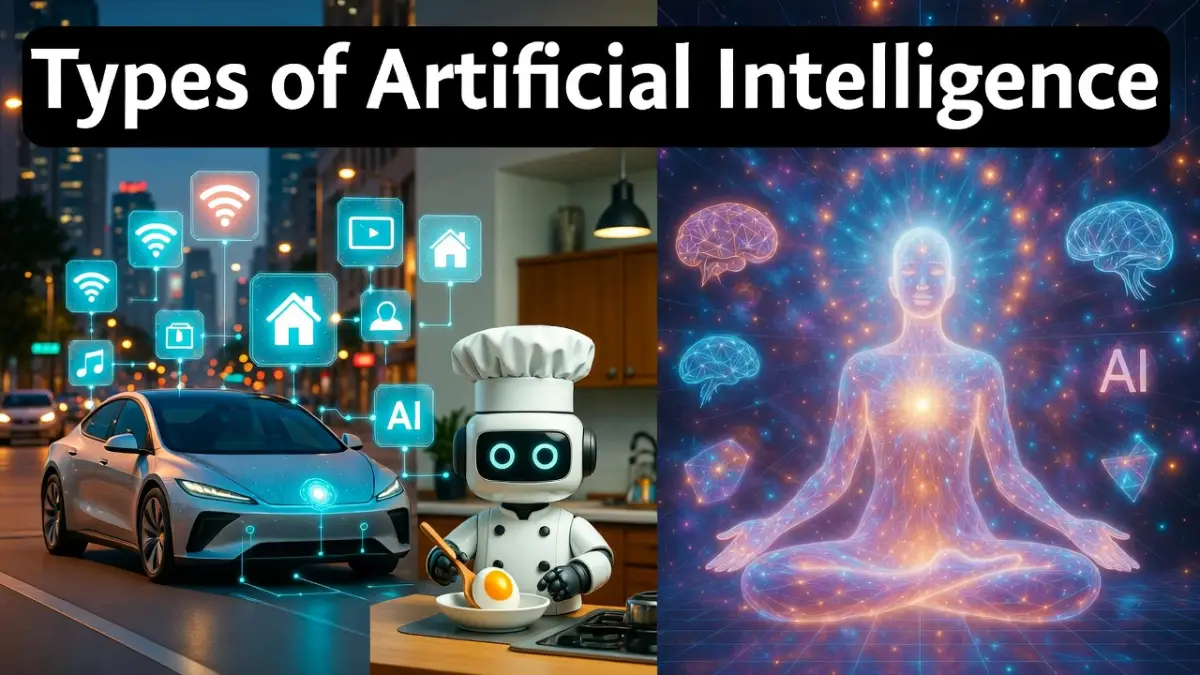
I’ve spent After years of building and evaluating software systems from clumsy lab experiments to the sleek, agentic systems of 2026. Most people view types of artificial intelligence as a monolith, but that’s a dangerous illusion. In my experience, the shift from rigid code to messy, adaptive neural patterns isn’t magic—it’s evolution. We are finally sculpting assistants that mirror our complex intuition, providing a safety net for our crowning glory: human creativity. It’s no longer about faster calculators; it’s about digital partners.
This evolution feels like stepping into a digital fitting room, where we try on different futures before committing to one. Instead of fearing a cold, robotic takeover, we should view these shifts as the safety net for your crowning glory—your unique human creativity. We aren’t just building faster calculators we are sculpting assistants that finally mirror our own complex, messy intuition.
Table of Contents
Two Ways to Classify Artificial Intelligence

After years of working with software systems and evaluating modern AI technologies, I have learned that understanding artificial intelligence requires two different perspectives. The first question I always ask is what level of intelligence a system can potentially achieve, while the second focuses on how it actually works behind the scenes. In my experience analyzing AI tools, many people confuse these concepts and assume every advanced model has human-like reasoning. Capability-based and functionality-based classifications help me separate real AI progress from exaggerated expectations.
Classification by Capability: Measuring AI Intelligence Levels
When I evaluate AI systems, I usually begin by looking at their overall intellectual capabilities rather than their features alone. Through my experience building and reviewing software solutions, I have found that most current applications still belong to Artificial Narrow Intelligence (ANI), designed for specific tasks such as coding assistance, recommendations, or automation. Artificial General Intelligence (AGI) represents a future stage where machines could transfer knowledge across different domains, while Artificial Superintelligence (ASI) remains a theoretical concept beyond current technology.
Classification by Functionality: Understanding How AI Works
In my practical experience working with AI-powered platforms, I have noticed that the way a system processes information often matters more than how impressive its output appears. Functionality-based classification helps me understand whether an AI reacts only to current inputs, learns from previous information, or could eventually understand human intentions. Reactive Machines and Limited Memory AI already exist in real-world applications, while Theory of Mind and Self-Aware AI represent future possibilities that researchers are still exploring.
Understanding Artificial Intelligence by Functionality
Reactive Machines: The Foundation of AI (Example: IBM Deep Blue)
Imagine a chess player who sees the board perfectly but forgets every match they’ve ever played. This is the reality of reactive machines, the most basic types of ai technology. They don’t have memories to lean on; they simply respond to the immediate present using pre-set rules. While IBM’s Deep Blue could crush a grandmaster, it lived entirely in the “now,” unable to learn from its past mistakes or predict a human opponent’s evolving mood.
Limited Memory AI: Learning from the Recent Past (Example: Self-driving cars)
Ever tried navigating a crowded sidewalk without remembering where the person behind you was two seconds ago? You’d likely crash. Limited memory AI solves this by observing the immediate past to make smarter future decisions. This is exactly how self-driving cars function—by tracking the speed and direction of nearby vehicles over time. Unlike reactive systems, these models build a temporary historical context, allowing them to navigate the messy, unpredictable flow of real-world traffic.
Theory of Mind: The Frontier of Emotional Intelligence

We’ve all experienced that awkward moment when a digital assistant misses the obvious frustration in our voice. To bridge this gap, researchers are chasing the “Theory of Mind,” an artificial intelligence classification that understands human emotions and intentions. This isn’t just about processing data; it’s about a machine recognizing that the person it’s talking to has their own unique beliefs and feelings. It is the essential step toward creating AI that truly “gets” us in social settings.
Self-Awareness: The Theoretical Peak of Artificial Consciousness
Self-awareness remains the ghost in the machine. While today’s artificial intelligence classification focuses on logic, this theoretical peak implies a system with a genuine ‘sense of self.’ We aren’t there yet, and anyone selling you ‘conscious AI’ in 2026 is likely peddling smoke and mirrors. True self-awareness would mean a machine that doesn’t just simulate a human response but actually experiences existence—a leap from sophisticated math to actual digital soul, which remains our final, uncrossed frontier.
Narrow vs. General: Types of Artificial Intelligence with Examples
Navigating the landscape of Types of Artificial Intelligence requires looking past the glossy interfaces of modern apps. While we often group all smart technology into one category, the industry actually separates these systems based on their intellectual capabilities and level of autonomy. Exploring intelligent systems examples reveals how different AI models handle reasoning, learning, and decision-making across various domains. This distinction helps people understand why specialized tools are not human-like minds and why a clear artificial intelligence systems framework is essential for realistic expectations.
Artificial Narrow Intelligence (ANI): The AI in Your Pocket
Types of Artificial Intelligence aren’t always grand or world-altering; sometimes, they just help you find a playlist. This is Artificial Narrow Intelligence (ANI), or “Weak AI.” It’s a specialist, like a world-class chef who only knows how to boil an egg perfectly. If you ask it to do anything outside its singular lane—like asking a spam filter to drive a car—it fails instantly. Despite this, ANI is the backbone of our current world, powering everything from Netflix suggestions to facial recognition.
Artificial General Intelligence (AGI): Myths vs. 2026 Reality
We often mistake the smooth-talking chatbots of today for true digital minds, but that is the “AGI Illusion.” Artificial General Intelligence (AGI) would be a system that can learn and apply knowledge across domains like humans. While 2026’s agentic workflows bring AI closer to advanced reasoning, true AGI with common sense remains unrealized. The evolution toward world models ai shows how AI is moving beyond chatbots by understanding environments and complex interactions. My research into intelligent systems reveals that these technologies are already transforming real-world problem solving in unexpected ways.
Artificial Superintelligence (ASI): Beyond Human Capacity
Then there is the final, terrifying leap: Artificial Superintelligence (ASI). This isn’t just a machine that’s “smart”; it’s a system that outpaces collective human genius in every field, from art to quantum physics. It’s the stuff of sci-fi nightmares and utopian dreams alike. If it ever arrives, it won’t just solve problems; it will redefine the very fabric of how we perceive reality.
The Modern Twist: Types of Generative AI in 2026

The old, dusty lines we drew to separate Types of Artificial Intelligence are effectively dead. Today’s generative models have stopped playing with words and started seizing executive power. It’s no longer about a machine guessing the next syllable in a sentence; it’s about deep, gritty integration into our workflows. We’re forced to gut our traditional artificial intelligence systems frameworks. Why? Because software has pivoted from being a silent library to an active, thinking participant that solves real-world messes with terrifyingly human-like precision.
The Evolution of AI: From Generative Models to Agentic Systems
The 2026 landscape is dominated by Agentic Systems—the true disruptors within the types of artificial intelligence hierarchy. I’ve watched these agents move past the ‘Chatbot Era’ to seize actual executive power. They don’t just talk; they act. By trying on different solutions in a digital fitting room before presenting the winner, these autonomous systems manage entire project lifespans while we sleep. It’s the transition from a machine that answers questions to a partner that solves real-world messes with grit.
Common Misconceptions: Artificial Intelligence Description vs. Reality
We’ve all felt that sting of a “bad trim”—expecting a masterpiece and walking out with a disaster because of a simple miscommunication. This same frustration haunts the tech world when people confuse a polished artificial intelligence description with actual sentient capability. We see a chatbot handle a complex poem and assume it “understands” love or loss. In truth, it’s just a high-speed prediction engine, not a soul.
Most users struggle with understanding artificial intelligence because they anthropomorphize code. They see a “Limited Memory” system and mistake it for human-like wisdom. It’s vital to realize that even the most impressive types of artificial intelligence today are essentially sophisticated mirrors reflecting back our own data. They don’t possess feelings or consciousness; they possess math. Recognizing this boundary is the safety net for your crowning glory—it prevents you from over-trusting a machine that can’t actually feel.
From My Ledger: 5 Intelligent Systems I’ve Evaluated in Production
To see how these concepts move from theoretical whitepapers into real-world applications, I evaluated several intelligent systems that are already transforming complex workflows and production environments. During my own architecture audits, I observed how modern AI solutions are moving beyond simple automation by analyzing data, making decisions, and executing tasks with increasing autonomy. This evolution is also reshaping the role of an AI software developer, as agentic systems now assist with debugging, optimization, and software lifecycle management. These examples prove that the boundary between data processing and real-world execution is rapidly disappearing.
| System | Classification | Example |
|---|---|---|
| AlphaFold 3 | Narrow AI | Drug discovery |
| Tesla FSD | Limited Memory AI | Autonomous driving |
| GitHub Copilot Agents | Agentic AI | Software development |
| ClimateEngine Nodes | Limited Memory / ANI | Analyzes petabytes of satellite |
| Automated Quant Pipelines | Reactive + Limited Memory | Orchestrates high-frequency |
Conclusion
Understanding the evolution of AI has become essential for anyone navigating the 2026 digital landscape. Throughout my experience evaluating intelligent systems and modern automation workflows, I have learned that these technologies are most valuable when we understand both their capabilities and their limitations. The future will not be defined by replacing human creativity, but by combining human judgment with increasingly autonomous tools. From reactive systems to advanced agentic models, knowing how these technologies work helps us make smarter decisions, avoid unrealistic expectations, and build a more responsible relationship with Types of Artificial Intelligence as it continues to evolve.


A really good blog and me back again.
Glad to have you back! Thanks for the kind words and your continued support 😊